Johannes Brahms (1833-1897) spent his early years playing piano in taverns and other unsavory locations, but by the end of his life he was considered one of the most important composers of the 19th century.
He owes his renown to the composer Robert Schumann, who became a mentor to Brahms and then used his considerable influence to promote the young composer as the next Beethoven.
Ironically, Brahms’ relationship with the Schumann family led to years of personal turmoil, and the comparisons to Beethoven gave him a massive complex.
Brahms wrote his masterworks in a period of transition, when composers were discarding the classical style of Haydn and Mozart. This outraged Brahms, who considered the new wave
(infidels like Wagner and Liszt) to be undisciplined and therefore inconsequential. Brahms became a fierce defender of the sonata form.
What is the sonata form? It was a formula for presenting musical ideas that was first developed by Haydn and later perfected by Mozart and Beethoven. You can read about the format here, and in order to understand Brahms you must above all understand how adamantly he felt about formal structures such as these.
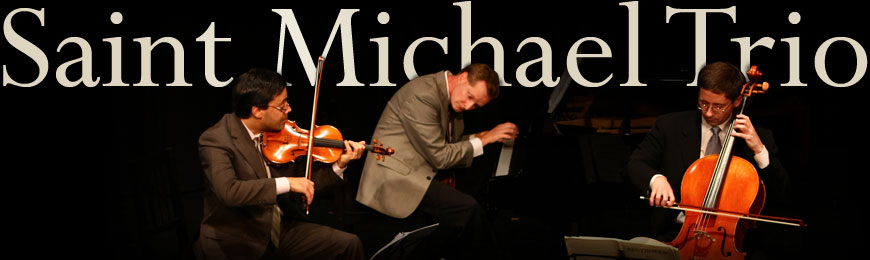
On September 17 at Stanford the Saint Michael Trio will present the landmark works from Brahms’ chamber music, show you his distinguishing features, and try to untangle some of his complexity. For portions of the program they will be joined by Stanford faculty violinist Robin Sharp, and violinist Julie Kim.
Works to be performed include:
-
Piano Trio No. 4 in C minor, Opus 101 (Scherzo: Presto non assai)
-
Piano Trio No. 1 in B Major, Opus 8 (first movement: Allegro con brio)
-
Piano Quartet No. 3 in C minor, Opus 60 (third movement: Andante)
-
Piano Quintet in F minor, Opus 34 (first movement: Allegro non troppo)
-
Piano Quintet in F minor, Opus 34 (Scherzo: Allegro)
All of the works to be performed are considered substantial achievements by the composer, ranking highly among his output. The Piano Quintet stands out even among these, and is seen by musicologists and historians as a culmination of the form.
If you’re interested to familiarize yourself with the Piano Quintet, Saint Mike enjoys this classic recording by Rudolf Serkin and the Budapest String Quartet.
Saint Mike greatly respects this recording of the B Major Piano Trio by Isaac Stern, Pablo Casals, and Myra Hess.
To get a broader view of the composer, you might also listen to his first symphony, the one he labored over with tremendous insecurity because people were expecting it to be on par with Beethoven’s. His insecurity notwithstanding, before his life was over people began referring to Brahms’ first symphony as “Beethoven’s Tenth.” This performance led by Leonard Bernstein and the Vienna Philharmonic shows you why.
People wanting to delve deeply—very deeply—into Brahms’ human complexity and how it shaped his music will want to read Jan Swafford’s masterful biography. Published in 1999, most consider it the definitive treatment.
Interesting factoid: Brahms was the first major composer to be recorded. In 1889 a representative of Thomas Edison was sent to Germany to make a wax cylinder recording of the master playing one of his Hungarian Dances at the piano. The recording survives, and is being preserved, de-noised, and enhanced by scientists in Stanford’s Sonic Archeology Project. You can hear fragments of it here, and learn more about the challenges of rescuing the world’s earliest recordings.